This project was done for the minor Designfull Innovation. In this minor I specialised in creating concepts for one billion people all over the world.
During this minor I tried to answer the question: ‘How might I change the meaning of digital data privacy for generation z and alpha?’
We had to formulate this HMI-question ourselves and I chose this one cause it is a relevant topic right now and most people are (negatively and positively) affected by data in their lifes.
The Final Product
The final answer to my HMI-question was a card game named: ‘Who owns your data?’
On the left you can see four people playing the game. Those four people are all different companies that try to buy as much data as they can, regardless of what type of data it is.
The playable companies are focused on: Social Media, Health Care, Government and Ads.
How is the game played? During the game different data cards are put in the middle of the table, these are pulled from a pile by one of the players. Each company then takes turns to bid on the card. The player with the highest bid in the end gets the card. The player with the most data cards when the pile is empty wins the game.
What data can be bought?
All data cards in this game are based on real data sets that people are profiled in. These data sets can be bought right now and many companies use them to exploit their audience.
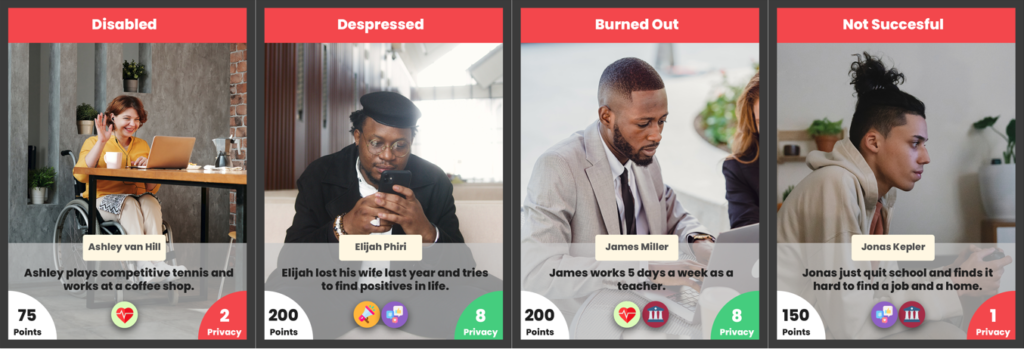
On the right you can see an example of one of the cards that can be bought in the game.
Extra mechanics Each company also has a hidden ability that they can use throughout the game, the ad company for example can change one of their existing cards to match it in their interest as they are very versatile and can use many types of data to their advantage.
Besides these abilities there are also event cards that can be pulled instead of a data card during a round of bidding, these also greatly affect the game.
An explanation of one of the data cards people are able to buy. (Many more data cards exist besides this one)
My Design Process
Take a look at my research and process! (Hold right-click to drag around)
Preliminary Research
For this project I had to choose two Sustainable Development Goals (SDG’s) that interested me. I chose the goals, Quality Education and Peace Justice & Strong Insitutions. These SDG’s are goals the UN wants to achieve by 2030.
Within these goals I started with Desk Research on the topic of Digital Data Privacy, because I think that this is a very relevant topic right now and is in desperate need for change.
Questions I had with this research:
How, what and why is data gathered?
What are the consequences for consumers?
What do people know about data privacy right now?
Research Key Insights
Selling of private data
Data brokers sell your data in very confronting data sets (combined pieces of data gathered from many places), sets like ‘Low income student’ or ‘Less successful people’. (Uba, 2016)
Using data for other purposes
Data is being used for things other than just advertising, like credit scores traditionally used for underwriting loans, are now being used by half of US employers to screen job applicants. (Uba, 2016)
Data from other sources
Data is gathered and sold not only from the internet or your phone, but also in smart cities, hospitals and at your job. (Heiligenstein, 2021)
Brainstorming
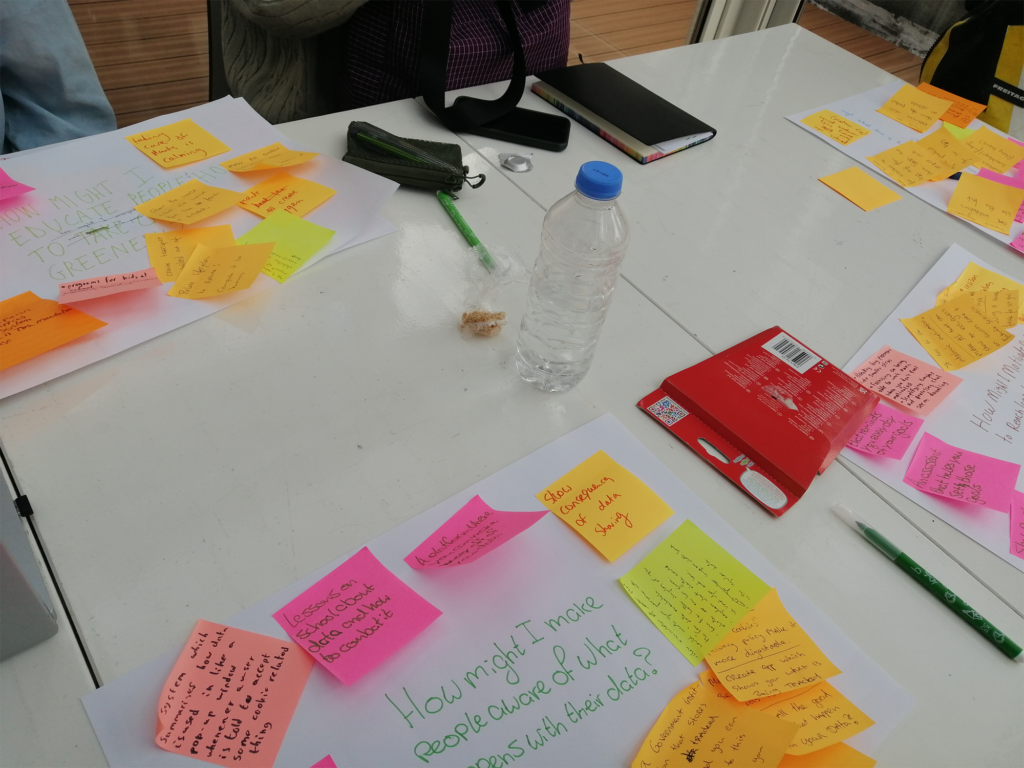
After Desk Research it was time for quick brainstorming. Together with other students I held a brainstorming session consisting of Brainwriting and a Negative brainstorm.
Most interesting ideas:
An app where you can sell your personal data to companies.
Something that scans your phone for what data is being collected.
Something that shocks people on what is happening with their data.
A popup window in your browser that tells you what data is collected.
After these methods I chose 3 ideas which spoke to me the most and worked them out in concept one pagers. I chose the app on which data can be sold, something that scans your phone and something that will shock and try to educate my target group.
At this time I chose the target group, the younger generation, because they will shape our future companies and will be able to make a change in how they deal with data. Later on on the process, this became a more focused target group, generation Z and Alpha.
Brainwriting and Negative Brainstorm session.
Three Concepts
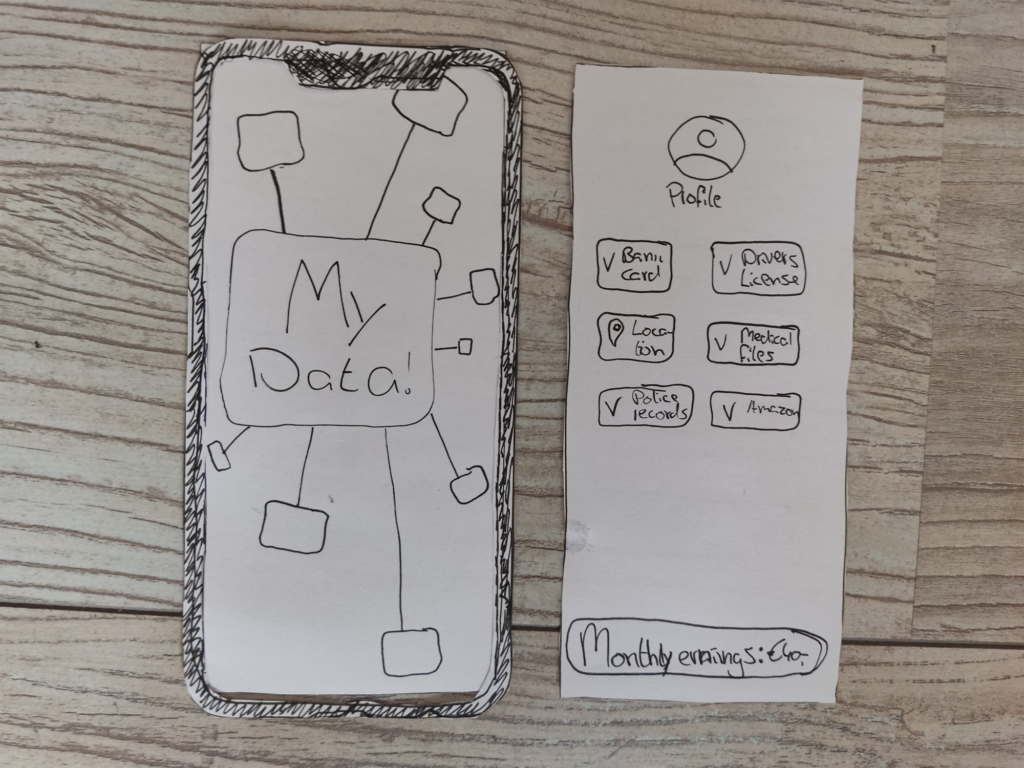
My Data!
This concept is a bit of an outlier. It is focused on a future where our society is already aware of data privacy and wants a solution for it. My Data is a platform where people can make a profile existing of many different types of data. You can put in your location, age, gender, medical records, drivers license, supermarket receipts etc. When you’ve made your profile you get the choice to sell your data to companies who you want. This way the consumer gets control over their data and gets a role in the brokerage of it.
Arts of Data
This is the concept that I eventually continued with (I explain why later in the process).
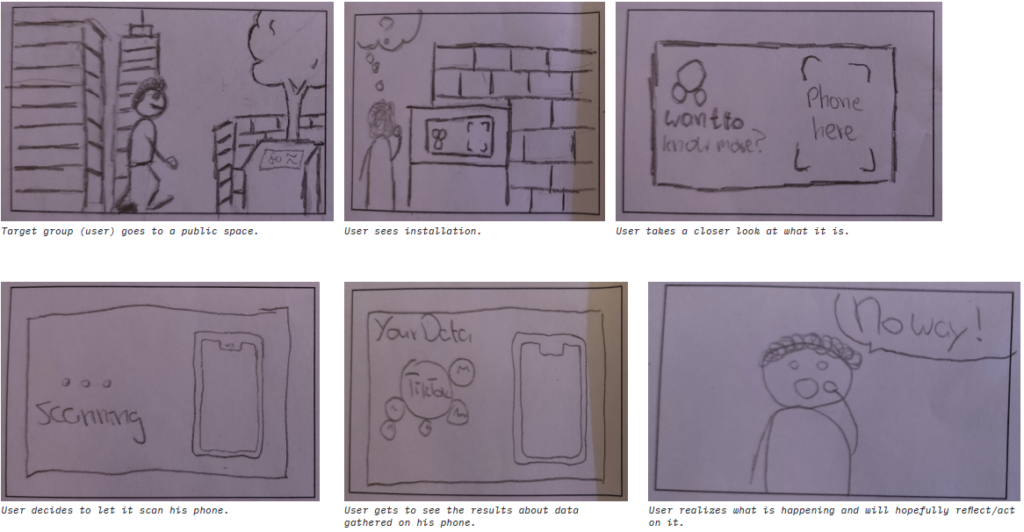
This concept is an installation where people come by and put their phone on. The installation then scans their phone and shows them what apps/companies are gathering their data and what they’re doing with it. This installation is used in public spaces, libraries or museums. It is also part of a bigger thing that gives people tips on how to improve on data privacy and other facts.
The Daily Life of You
This concept is a game about the normal life of a teenager. Within this game the players make choices for the character’s life. A choice could be to download TikTok or not. After that the players get to see what the effect of that is on the character and what is happening behind the scenes. This game is played in class to promote discussion and the making of choices together as a group. (Teaching and Learning Transformation Center, 2018)
Testing & Interviews
With these usability tests i wanted to find out which concept to continue with and which one had the most value.
With the semi-structured interviews I wanted to find out if my assumptions and earlier research were valid.
I eventually chose to continue with the concept named “Arts of Data“. This concept held the most value, because it is wat shocked my target group the most and put them thinking on the subject of Data Privacy.
Storyboard
Interactive Prototype
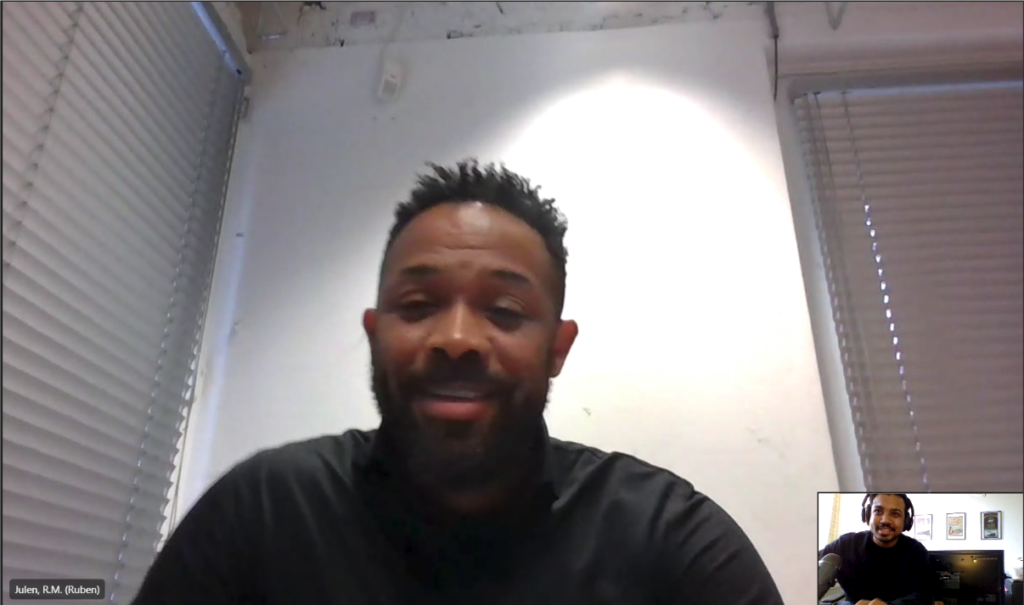
One of the experts I spoke to review my innovation with. Ruben is a data analytic who works at the data lab of Hogeschool Rotterdam.
Kill Your Darling & Expert Reviews
At this moment I had just done Dragons’ Den presentations for around four experts in the field of my innovation and held interviews with several data and AI analytics. (Dragons’ Den presentations are quick pitches, where you try to sell your product to the experts that are listening)
The feedback that they all gave me was that people need more literacy around data privacy and that there currently are no means of getting into the subject in an entry level way.
In summary: If people aren’t aware, they can’t even start to understand the world of data privacy.
With all the feedback from the experts and Dragons’ Den sessions, I had to make the tough decision to ‘Kill my Darling’. I scrapped my old prototype in favour for a new idea that would make people aware of what is happening with their data.
Design Principles
The Design Principles, Guidelines and Criteria were made right after I made the decision to ‘Kill my Darling’. This was the perfect time to redefine what me and my innovation stood for. On the right you can see which Principles made it through.
Here’s a short explanation of each principle:
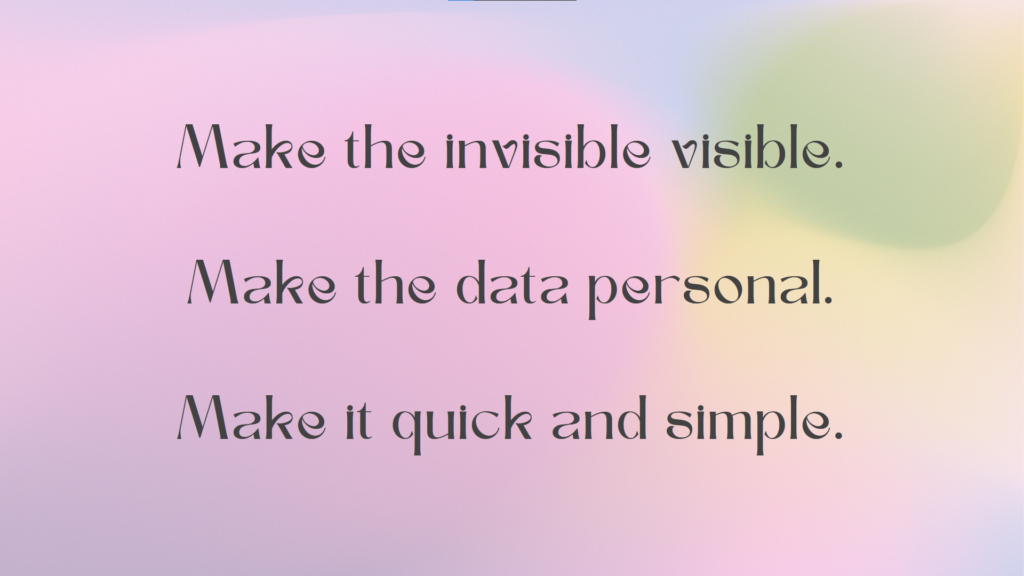
Make the invisible visible: Data shared and sold must be made visible in a game or simple element.
Make the data personal: The shown data must be personal and relatable.
Make it quick and simple: The explanations and data need to be shown and interpreted in one look.
The Round Robin Brainstorm I held with my classmates.
Round Robin Brainstorm
Togetherwiththeprinciples,Istartedabrainstormsessiontofind ideas on how I canmaketheinvisiblevisible,howIcanmakesomethingthatis really personal andalsosimple?
Manyideascametofruition,buttheonethatstood out the most wasacardgame.Acardgamewheretheplayerscompetewitheach other as the companies,tryingtobuyasmuchdataastheycan.
Prototype V1 + Testing
Thefirstprototypewasreallysimple and was mostly usedforaproofofconcept.
Thecardgamewentasfollows:
Theplayerseachgetacompanycard, without them showingittoeachother.
Theythendecidewhostartsthegame. That person thenpullsacardfromthedatapile and puts it in themiddle.
Now,clockwiseeveryone,exceptfor the player who pulledthecard,willstartbidding on the card one byone.
Thebiddinggoesontillnoonewants to bid higher andthemoneygoestotheplayerthat pulled the card.
InresearchfromMartin,Iconcluded that these four companiesarethelargestcompanies that collect data frompeople (See the image on the right).(2020)Alsoinresearch from Robinson et al.,theyfoundthatyourdataisworth around 2-3k eurosayear.(2017) Thedatasetsusedinthisprototype are also based onresearch.InresearchfromRieke et al., it is shownthatdatasetsarebeingsold that are much more intrusivethanpeoplethink.(2016)
WiththisprototypeIwantedtotest if the datasets I putonthecardswereshockingenough for my audience. Ithenproceededtotestitwithausability test. I gavetheparticipantsashortexplanation of the game andletthemplayitout.Thistest was conducted twice,thefirsttimewiththreestudents and the other onewith4teenagers. IninsightsIgainedfromthis:
‘Itfeelsreallyunethicaltobid on real people.’
Iwishthereweremore‘game-like’ mechanics in the game.(Likestealingcardsorlosing a card)
‘Arethesereallydatasetsthatare being sold?’
‘Isitevenokaytosellthedata of a minor, withoutconsent?’
Iwishthecompaniesaddedmorethan just the names.Whatreallymakesanadcompanyan ad company?
ThetestprovedwhatIwantedtoachieve. The data sets wereconfrontingandfeltabitpersonal already. With theseinsightsIdecidedtoiterate on it once more, addingmoregame-likeelements.
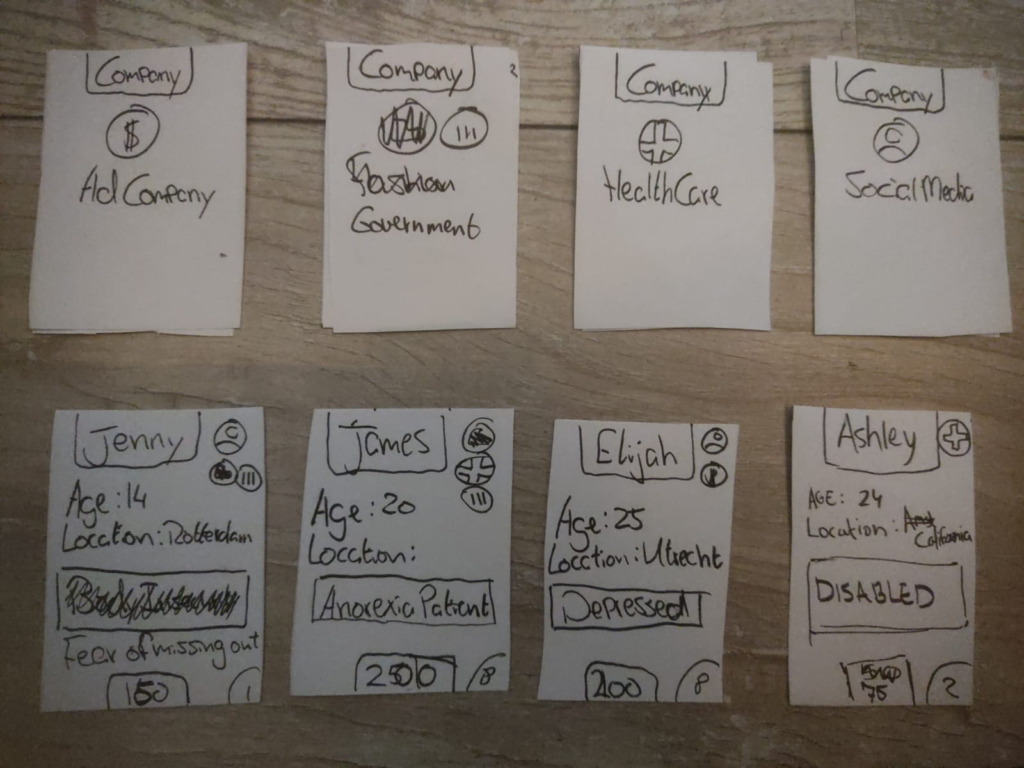
The first paper prototype of my card game about data privacy. On top you can see the playable companies and on the bottom, the data you are able to buy throughout the game.
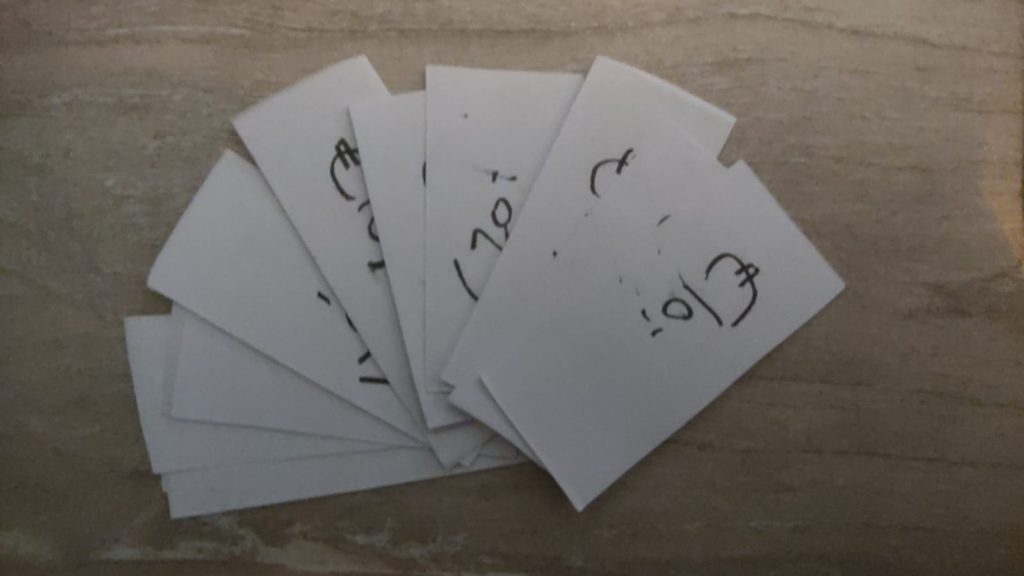
The money that is used to buy the data cards throughout the game, these range from 10-100 euro bills.
A few of the event cards.
The unique abilities that each company got.
Prototype V2 + Testing
Based on feedback I decided to add more game like mechanics and personality to the playable companies. The improvements were:
Several event cards were added to the data pile, such as a data breach that resulted in loss of data.
Each company gained a unique ability to influence the game with, such as the government that could swap data with another company.
After the improvements I tested it twice with my target audience and got the following insights:
‘Isthisreallyhowmydataisbeing sold?’
‘Iwishtherewasmoredepthtothe people, who are theyreally?’
‘Iwishtherewasmoreinfoonthe companies, how do theyreallyoperate?’
Prototype V3
The last iteration was a large one. The significant things I added were:
A new design for the data and event cards.
A new design for the company cards.
I added a screen for each player company to keep their business even more hidden from the other players. This screen also included info on the game and their company. The screens told the players how the companies deal with their data, good and bad.
A new design for the money cards.
This last iteration was more about applying and evaluating the prototype with my design principles. Was it showing everything that is invisible? Does it include personal data? And is it easy to understand?
On the right you can see the final prototype. Unfortunately I wasn’t able to test it before the final exposition, but the game was mechanic wise the same as the second iteration.
Insights I gained from the exposition: • Some event cards are difficult to counter or play with. • People wanted to see a reward for having the most money at the end of the game. • It once again confirmed that there is a need for a game like this, because it opened a lot of conversations on data privacy and on what is really happening behind the scenes.
The final version of the data cards.
The final version of the company screens. (This is the one for the social media company)